Basement Carpet That Survives a Kingston Winter: Picking Underlay for Concrete Slabs
Carpet is a comfortable choice for a finished basement. It makes a concrete floor feel warmer, helps with sound, and works well in family rooms, bedrooms, offices, and home theatres.
But there is one thing we would check before talking about carpet or underlay: the concrete floor.
A basement can look perfectly dry and still have moisture moving through the slab. An older basement can also have a completely different set of problems from a newer poured-concrete foundation. No carpet pad, regardless of what it says on the label, can make a wet basement dry.
So before choosing the softest carpet sample in the store, find out what is happening underneath it.

What to Know Before Putting Carpet in a Basement
A suitable basement can absolutely have carpet. The question is whether the slab and the rest of the floor assembly are suitable for the particular carpet, cushion, adhesive, and installation method being considered.
There are three moisture issues worth separating.
Water coming into the basement
This is the easiest one to understand.
Leaks, seepage through foundation walls, plumbing problems, flooding, and water entering through cracks or joints need to be dealt with before carpet is installed.
If water is getting into the basement now, installing a different carpet pad isn’t a solution. It just puts a finished floor over the problem.
Moisture coming through the concrete
Concrete isn’t necessarily dry just because its surface looks dry.
Moisture can move through a slab from the ground below. Whether that amount of moisture is acceptable depends on the flooring system being installed.
This is why concrete moisture testing is important for many basement installations. The result needs to be compared with the requirements for the actual flooring and adhesive, rather than a generic number found online.
Condensation
There is another possibility that sometimes gets overlooked.
A basement slab can be cold. When warm, humid air reaches a sufficiently cold surface, condensation can occur.
That isn’t the same thing as moisture travelling through the concrete.
Keeping basement humidity under control is therefore part of looking after a carpeted basement, particularly during Kingston’s more humid summer weather.
How to Tell If Your Basement Needs More Investigation
Start with a visual inspection.
Look for:
- White or chalky deposits on the concrete
- Old water stains
- Musty smells
- Damp spots around foundation walls
- Cracks with signs of water entry
- Evidence of previous flooding
- Condensation during humid weather
- Problems with a sump pump or basement drainage
Also ask what has happened in the basement over the years.
A basement that has never had a water problem is one thing. A basement that floods every spring is another.
If you’re not sure what you’re looking at, this is a good point to have the floor and basement conditions assessed before buying carpet.
Does the Concrete Need to Be Moisture Tested?
If the flooring manufacturer’s installation requirements call for testing, yes.
Methods such as in-situ relative humidity testing and calcium chloride testing can be used, depending on the flooring system and the applicable requirements.
There isn’t one universal moisture reading that means every carpet can be installed over every concrete slab.
That’s an important point because a contractor who says, “The floor is concrete, so it’s fine,” hasn’t really answered the question.
The proposed carpet, cushion, adhesive, and any moisture-control product need to be considered together.
If the slab doesn’t meet the requirements, stop there and figure out why.
What If the Basement Slab Has Too Much Moisture?
The answer depends on the source.
If water is entering the basement, the solution may involve drainage, foundation repairs, grading, a sump-pump system, plumbing repairs, or another building-envelope issue.
If the concrete is sound but moisture vapour is too high for the proposed flooring, a compatible concrete moisture-mitigation system may be an option.
The important thing is not to confuse those situations.
A moisture-resistant carpet cushion is not basement waterproofing.
It can be the right component of a flooring system, but it isn’t there to hide an active water problem.
Choosing Carpet Underlay for a Basement
The cushion, or underlay, affects more than how soft the carpet feels.
It influences comfort, wear, carpet performance, and the way the floor feels underfoot. In a basement, its moisture characteristics also deserve attention.
Closed-cell foam
Closed-cell foam generally absorbs less water than absorbent cushion materials. Depending on the product and installation system, that can make it a useful choice for a basement.
Don’t assume all foam cushions are identical, though. Check the specifications for the actual product being installed.
Cushion with a moisture-control layer
Some carpet cushions are manufactured with an integrated film or other moisture-control layer.
This can be useful when the product is specifically approved for the proposed floor assembly. It is usually better than improvising a separate plastic layer underneath a standard carpet pad.
The manufacturer’s instructions still apply.
Rebond cushion
Rebond is popular for good reason. It offers a good combination of cushioning, durability, and cost.
But standard rebond should not automatically be treated as a moisture barrier.
If moisture is a concern, choose the cushion based on the actual conditions rather than assuming that a particular pad is suitable simply because it is commonly used in basements.
Absorbent cushions
Materials that readily hold moisture are less attractive when you’re dealing with a basement that has moisture concerns.
The answer isn’t necessarily “buy the thickest pad available.” A cushion that is too thick or too soft can also affect carpet performance.
For basement carpet installation, the carpet and cushion should be selected as a pair, with the concrete and installation method considered at the same time.
Carpet Tile or Broadloom?
Both are legitimate basement options. The better one depends on how you use the space.
Broadloom
Broadloom gives you the traditional wall-to-wall carpet look.
It’s a good fit for a finished basement family room, bedroom, office, or home theatre where you want the floor to look and feel like the rest of the house.
A stretch-in installation normally uses tack strip around the perimeter and a separate cushion. Concrete changes some of the details compared with installing carpet over a wood subfloor, so the installer needs to plan accordingly.
If you’re considering wall-to-wall carpet installation, the basement should be treated as its own installation rather than simply copying what was done upstairs.
Carpet tile
Carpet tile is worth considering when easy repairs are a priority.
If one section gets badly stained or damaged, you may be able to replace that tile rather than replacing the entire floor.
That’s particularly useful in a basement that gets a lot of use, or in a space where there is a higher chance of spills, pets, exercise equipment, or other wear.
Depending on the product, carpet tile can also be installed directly over a properly prepared concrete slab using an approved adhesive or installation system.
A carpet tile installation still requires a suitable slab. Tile isn’t a workaround for excessive moisture.
For a polished finished basement, we would generally lean toward broadloom when appearance and comfort are the priority. If easy maintenance and spot replacement matter more, carpet tile deserves a closer look.
Which Carpet Fibre Should You Use?
For most basement projects, synthetic fibres are the sensible starting point.
Nylon
Nylon is durable and resilient. It handles regular foot traffic well and tends to recover from crushing better than many other fibres.
That makes it a good choice for a finished basement that gets used every day.
It isn’t waterproof, though. The fibre doesn’t eliminate the need to deal with basement moisture.
Polypropylene (olefin)
Polypropylene absorbs very little moisture, which is one reason it is commonly considered for areas where moisture resistance matters.
Its weakness is resilience. It generally doesn’t bounce back from crushing as well as nylon.
If you’re putting a heavy sectional sofa or other furniture in the room, that’s worth considering.
Wool and other natural fibres
Wool has plenty of advantages in the right setting, but a basement isn’t necessarily where we’d start.
It absorbs moisture and requires more careful environmental control. If the basement has any history of dampness, synthetic options are generally easier to live with.
Don’t Forget the Carpet Backing
The fibre isn’t the whole carpet.
Backing materials and construction can affect how a carpet handles moisture, how it is installed, and which adhesives or cushions can be used with it.
Before choosing a carpet for a basement, ask about:
- The primary and secondary backing
- The recommended cushion
- The approved installation method
- Adhesive requirements
- Moisture limitations
- Below-grade installation restrictions
- Warranty requirements
This is one reason we don’t like choosing the carpet first and figuring out the rest afterward.
The materials need to work together.
Should You Put Plastic Under the Carpet Pad?
This is one of those basement questions where a simple internet answer can cause problems.
A sheet of polyethylene placed over concrete isn’t automatically the right answer.
Depending on the floor assembly, adding a plastic layer can affect moisture movement and condensation. It may also conflict with the requirements of the carpet, cushion, adhesive, or installation method.
If a moisture-control layer is necessary, use a product designed for that application and make sure it is compatible with the rest of the flooring system.
And if water is actually entering the basement, fix the water problem rather than trying to seal it underneath carpet.
Preparing a Concrete Slab for Carpet
Moisture isn’t the only thing that can cause trouble.
The slab should also be checked for:
- Cracks
- Uneven areas
- High spots
- Loose concrete
- Old adhesive
- Paint or coatings
- Dirt and contamination
- Areas that aren’t suitable for adhesive bonding
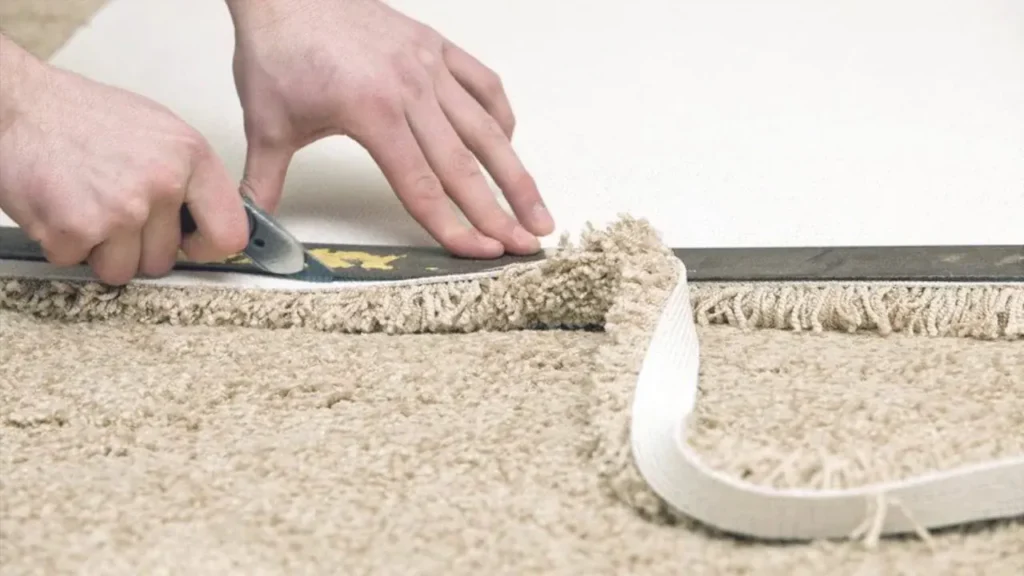
A high spot might need grinding. A low area might need patching or a suitable levelling compound. Cracks may need repair depending on their size and cause.
The preparation required depends on the flooring system.
The basic goal is straightforward: clean, sound, adequately flat concrete that is suitable for the installation method being used.
What About Older Kingston Basements?
This is where local experience becomes useful.
Kingston has plenty of older homes, and not every basement was built with the same materials or moisture-control details as a modern house.
You can encounter stone, rubble, brick, and other older foundation construction. Some of these basements have performed perfectly well for decades. Others have a long history of dampness.
Don’t assume that an old basement is unsuitable for carpet. Just don’t assume it’s the same as a new poured-concrete basement either.
The foundation walls, drainage, slab, humidity, and history of the basement all tell you more than the age of the house by itself.
The same goes for nearby communities such as Amherstview, Bath, and Napanee.
The useful question isn’t, “How old is the house?”
It’s:
What condition is this basement actually in, and which flooring system makes sense for it?
What If Your Existing Basement Carpet Is Already Causing Problems?
Don’t assume every carpet problem is caused by moisture.
For example, carpet can develop ripples because it has lost tension over time. Heavy furniture can also leave permanent crushing.
Other symptoms are more concerning.
Watch for:
- Persistent musty odours
- Damp or discoloured carpet
- Staining around foundation walls
- Recurring smells after rain
- A cushion that feels deteriorated
- Carpet separating from the perimeter
- Rippling accompanied by other signs of moisture
If the carpet has simply become loose and the slab and cushion are otherwise in good condition, carpet restretching may be all that’s needed.
If the cushion has broken down or there are signs of recurring moisture, stretching the carpet won’t fix the underlying problem.
In that situation, carpet removal followed by an inspection of the slab makes more sense.
A Simple Checklist Before Installing Basement Carpet
Before approving the installation, make sure you can answer these questions:
Has the concrete been checked for moisture?
If testing is required for the flooring system, get it done.
Is water entering the basement?
If it is, solve that problem first.
What type of moisture is involved?
Water intrusion, vapour transmission, and condensation aren’t interchangeable.
What carpet and backing are being installed?
Check that the product is suitable for the intended environment.
Which cushion is being used?
Get the actual product information rather than accepting “basement pad” as an answer.
How will the carpet be installed?
Stretch-in, glue-down, and carpet tile installations have different requirements.
Are the products compatible?
The carpet, cushion, adhesive, and any moisture-control product should be suitable for use together.
What happens if the slab doesn’t pass?
There should be a plan for dealing with the problem before the carpet goes down.
Frequently Asked Questions
Can any carpet be installed in a basement?
No.
The basement needs to be suitable for carpet, and the carpet, backing, cushion, adhesive, and installation method need to be appropriate for the conditions.
Nylon and polypropylene are both reasonable synthetic options, but neither one fixes a moisture problem.
Is carpet tile better than broadloom in a basement?
Not automatically.
Carpet tile is attractive when individual sections may need to be replaced. Broadloom is usually the better choice when you want a traditional wall-to-wall finish and a softer residential feel.
How can I tell if my basement is too damp for carpet?
Look for water stains, efflorescence, musty smells, condensation, and previous flooding.
Those signs are useful, but concrete moisture testing is a better way to determine whether the slab meets the requirements of the proposed flooring system.
Is rebond pad okay for basement carpet?
It can be, depending on the product and the conditions.
Standard rebond should not be assumed to be a moisture barrier. If moisture is a concern, choose a cushion that is appropriate for the measured conditions and the carpet being installed.
Can I put plastic underneath the carpet pad?
Don’t do it automatically.
A plastic layer may be appropriate in some floor assemblies, but it can be the wrong choice in others. Any moisture-control layer should be selected to work with the complete flooring system.
Do newer homes need moisture testing?
A newer basement may have better moisture protection, but that doesn’t guarantee that the slab meets the requirements of a particular flooring system.
If the manufacturer requires testing, the slab should be tested regardless of the home’s age.
How much does basement carpet installation cost in Kingston?
There isn’t one useful price per square foot that covers every basement.
The final cost depends on the carpet, cushion, room size, installation method, condition of the concrete, and any preparation or moisture-related work required.
Our cost calculator can help with an initial estimate. A site assessment gives you a much better idea of what the finished installation will actually involve.
If you’re ready to discuss the project, you can request a quote.
The Bottom Line
A good basement carpet installation starts with the floor underneath it.
Check the concrete. Find out whether there is any water or excessive moisture. Choose the carpet and cushion together. Make sure the installation method suits the slab.
Then install it properly.
For a dry, suitable basement, carpet can be an excellent finished-floor option. Nylon and polypropylene are both worth considering, and broadloom and carpet tile each have their place.
But if the basement is wet, don’t spend your money looking for a better carpet pad.
Fix the moisture problem first.