Carpeting Old Staircases in Kingston: How Installers Handle Uneven Treads
Older staircases can look straightforward until the existing carpet comes off.
Underneath, you may find treads that differ slightly in size, old staple and tack-strip holes, patched areas, worn nosings, or sections of wood that have been repaired over the years. None of those conditions automatically means the staircase can’t be carpeted. They do mean the installer needs to assess the stairs as they actually exist rather than assume every step has identical dimensions.
For homeowners in Kingston with an older staircase, the condition of the stairs underneath the carpet can be just as important as the carpet itself.
Uneven Stair Treads Are Common in Older Homes
Older staircases may have more variation than a newer staircase. Tread depths can differ slightly, widths may change, and individual stairs may have been repaired or replaced during the home’s history.
There are several possible reasons. The staircase may have been built with normal construction tolerances, wood can change dimensionally with moisture and seasonal conditions, and buildings can move over time. Previous renovations or repairs can also change individual stairs.
A small difference may be difficult to notice when the staircase is bare. With a runner, however, the exposed wood along each side can make variations in tread width or alignment more noticeable.
The important question for a carpet installation isn’t necessarily why a particular stair is different. It is whether the variation affects the fit, appearance, preparation, or condition of the finished installation.
That is why measuring a staircase involves more than simply counting the steps.
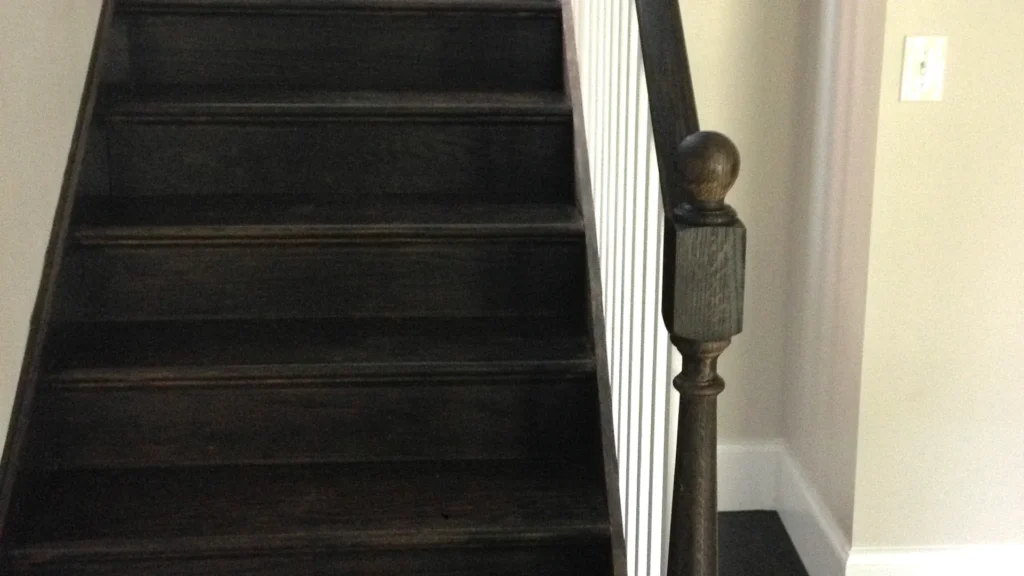
What to Look At Before Installing Carpet
When an older staircase already has carpet, the condition of the underlying stairs may not be obvious until the old material is removed.
An assessment can include:
- Tread depth and width
- Riser height
- Stair nosings and edges
- Loose or damaged boards
- Previous repairs
- Staple and tack-strip holes
- Adhesive residue
- Worn or deteriorated wood
- Winders and landings
- Areas where the stairs are not square
Not every imperfection needs to be repaired before carpet is installed.
A few old staple holes, for example, may simply be evidence of a previous carpet installation. A tread that moves when someone steps on it is different. That could indicate an underlying problem that should be addressed before new carpet covers the stair.
The goal is not to make every old staircase look newly constructed. It is to determine whether the existing surface is suitable for the planned installation.
Can Uneven Stairs Still Be Carpeted?
In many cases, yes.
Carpet does not require every stair to have exactly the same dimensions. The installation can be planned around the staircase that is actually in the home.
Minor differences can often be accommodated during installation. More substantial variations require closer attention, particularly where they affect the edges of the carpet or the amount of exposed wood.
This distinction is especially important with stair runners.
Full stair carpet covers most of the underlying wood, so some variations may be less noticeable. A runner leaves the sides of the treads exposed, making changes in width or alignment more visible.
That doesn’t make a runner unsuitable. It means the installer should consider those variations when planning the finished layout.
Full Carpet or a Stair Runner?
Both options can work on an older staircase. The better fit depends on the condition of the stairs and the appearance you want.
A stair runner can be a good option when the existing wood is attractive and worth leaving visible. It also provides a way to add carpet without covering the entire stair surface.
Full stair carpet may be more practical when the wood is heavily worn, patched, stained, or otherwise not something you want exposed.
The shape and consistency of the staircase also matter.
With a runner, the exposed wood borders need to look intentional from the bottom of the staircase to the top. If tread widths vary significantly, the installer needs to account for those differences when planning the runner.
With full carpet, more of those variations are concealed.
The choice should therefore be based on the condition and dimensions of the actual staircase, not just the appearance of a carpet sample.
What Happens When the Old Carpet Comes Off?
Removing old carpet is often when the condition of an older staircase becomes much clearer.
A previous installation may have left:
- Staple holes
- Tack-strip holes
- Adhesive residue
- Damaged wood around the edges
- Worn nosings
- Previous patches
- Sections repaired by earlier owners
Some preparation is normal. The question is whether the underlying surface is still suitable for the new installation.
If a tread is damaged, loose, or structurally questionable, installing new carpet does not fix the underlying problem. The stair should be assessed and, where necessary, repaired first.
On the other hand, the wood underneath does not need to be perfect simply because new carpet is going over it. Minor holes and cosmetic imperfections may not require extensive carpentry.
The amount of preparation depends on the condition of the individual staircase.
What About Stair Padding?
Stair padding should be selected for stair use and for the particular carpet and installation.
A thick, soft pad that feels comfortable underfoot in a bedroom isn’t necessarily appropriate for stairs. Excessive cushioning can change the feel of the step and affect how the carpet sits around the stair edges.
The condition of the staircase matters as well.
Padding can provide cushioning and support for the carpet, but it is not a substitute for repairing a damaged or unstable tread.
If a stair moves, feels soft, or has another underlying problem, that should be investigated separately before the carpet is installed.
What If the Existing Stair Carpet Is Loose?
Replacement isn’t always necessary.
If the existing carpet is still in reasonable condition but has developed ripples or become loose, restretching may be possible. Whether it makes sense depends on factors such as the carpet’s age, condition, backing, and the way it was originally installed.
There is little value in restretching carpet that is already badly worn or deteriorating. If the material still has useful life and the primary problem is loss of tension, however, repair may be worth considering.
There is an important distinction:
Loose carpet and a loose stair are not the same problem.
If the carpet has pulled loose, the installation may need attention. If the stair itself moves when stepped on, the underlying staircase should be assessed before carpeting.
Carpet installation is not a substitute for repairing an unstable or damaged tread.
When Does a Stair Need Repair Before Carpet?
That depends on the condition of the individual stair.
A worn finish may be primarily cosmetic. A cracked, loose, or deteriorated tread can be a different matter.
Before carpeting an older staircase, it is worth identifying anything that could affect the installation or the condition of the finished stairs, including:
- Loose treads
- Damaged nosings
- Significant movement
- Soft or deteriorated wood
- Missing sections
- Previous repairs that are no longer sound
Not every older stair requires carpentry work. The objective is to make sure the staircase is sound and provides a suitable surface for the carpet installation.
Why Measuring Old Stairs Matters
Knowing that a staircase has 13 steps doesn’t tell an installer everything needed to plan the job.
The tread dimensions, riser heights, stair shape, condition of the existing surfaces, and any winders or landings can all affect the installation.
This is particularly important when the stairs aren’t uniform.
For a straightforward staircase, measuring may be relatively simple. An older staircase with irregular dimensions can require more attention because the installer needs to account for the differences rather than assume every step follows the same measurements.
An in-home measurement also gives the installer an opportunity to identify preparation or repair work that may affect the final cost.
What Should Be Included in a Stair Carpet Quote?
For an older staircase, the carpet itself is only one part of the project.
Depending on the condition of the stairs and the scope of the work, a quote may need to account for:
- Carpet
- Stair padding
- Installation labour
- Removal of existing carpet
- Disposal
- Removal of old staples or tack strips
- Surface preparation
- Minor repairs
- Runner installation
- Work around landings or unusual stairs
The condition of the staircase can change the amount of preparation required. That’s why an on-site assessment is generally more useful than pricing an older staircase from a step count alone.

Questions Worth Asking the Installer
Before agreeing to the work, ask a few practical questions.
Will you inspect the stairs underneath the existing carpet?
Some problems won’t be visible until the old material is removed.
Are the stairs suitable for a runner?
If the tread widths or shapes vary, ask how that will affect the finished appearance.
Does the existing padding need to be replaced?
Old padding can become compressed or deteriorated and may not be appropriate for a new installation.
Are repairs included in the quote?
Find out whether preparation and minor repairs are included or priced separately.
Could the existing carpet be restretched instead?
If the carpet is still in good condition, replacement may not be necessary.
A Runner Can Work on an Older Staircase
An older staircase does not need perfectly uniform treads for a runner to be considered.
What matters is how much the stairs vary, the condition of the wood, and what the finished installation will look like.
If the wood is attractive and the variations are manageable, a runner can preserve some of the character of the staircase while adding carpet where it is needed.
If the stairs have extensive surface damage, inconsistent edges, or wood that isn’t worth exposing, full stair carpet may be more practical.
The right choice becomes easier to determine after the staircase has been measured and inspected.
Carpet Installation for Older Kingston Homes
Older staircases can require more attention than a straightforward modern installation, but uneven treads do not automatically prevent carpeting.
The important steps are to assess the condition of the stairs, measure the dimensions that matter, identify any repairs or preparation required, and choose an installation approach that suits the staircase.
For homeowners in Kingston, Carpet Experts Kingston can assess an existing staircase, discuss full carpeting or a runner, and identify preparation or repair work before installation begins.
You can also review the company’s information on stair carpet installation, carpet installation, stair runners, carpet restretching, and carpet repair.
Frequently Asked Questions
Can carpet be installed on uneven stairs?
In many cases, yes. Minor differences between treads can often be accommodated during installation. More substantial irregularities should be assessed individually.
Do all stair treads have to be exactly the same size?
No. Some variation does not automatically prevent carpet installation. The installer needs to work with the dimensions that are actually present.
Is a runner a bad idea for an old staircase?
Not necessarily. A runner can work well when the underlying wood is worth showing and the variations between the stairs can be accommodated without creating an undesirable finished appearance.
Should loose carpet on stairs be replaced?
Not automatically. If the carpet is still in good condition, restretching or another repair may be possible.
What if the stair itself moves?
The underlying stair should be assessed before new carpet is installed. Carpet should not be relied upon to correct an unstable or damaged tread.
Will removing old carpet damage the stairs?
Older carpet can leave staple holes, tack-strip holes, adhesive, and other marks. These don’t necessarily cause a problem, but the condition of the wood should be checked once the old material is removed.
Can I get a stair carpet price without an in-home measurement?
A rough estimate may be possible, but an on-site measurement is more useful for an older staircase. Variations in dimensions and the condition of the stairs can affect the amount of work required.
Is full stair carpet better than a runner?
Neither is automatically better. Full carpet conceals more of the underlying stair, while a runner leaves the wood visible. The condition and shape of the staircase should be considered before choosing between them.