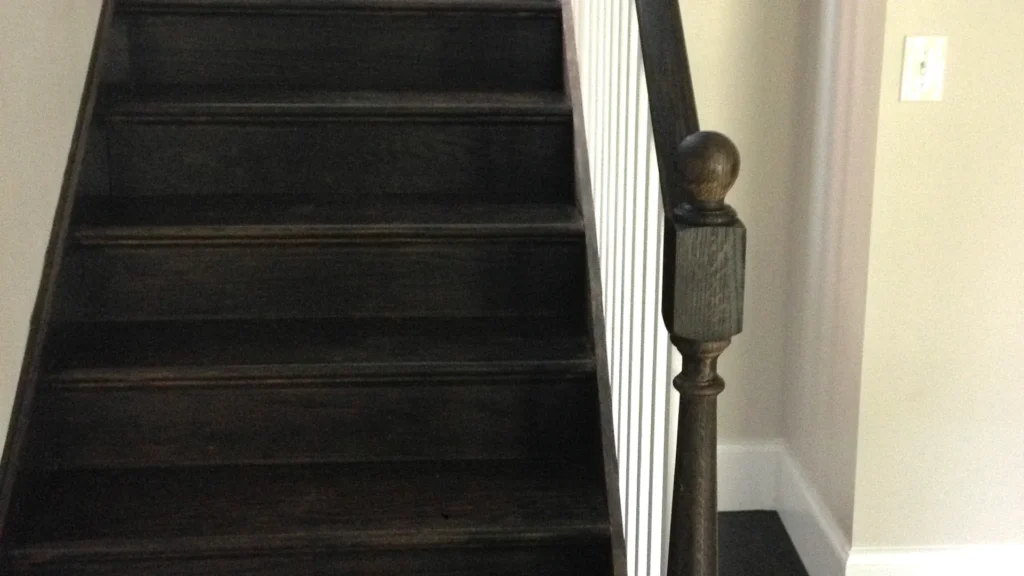
Carpet Experts Kingston installs stair runners on hardwood staircases across Kingston, Ontario – wood left exposed on both sides, the runner centred and held tight on every tread.
Request a Quote
Tell us about your project and we will get back to you within 24 hours.
Your information is secure and never shared.
What Makes a Runner Different From Stair Carpet
The Reveal Has to Be Even
A runner leaves finished wood showing on both sides of every tread, and that margin – the reveal – is what the eye actually judges. If a staircase has drifted out of square, as many older Kingston homes have, a runner centred by tape measure alone will look crooked. We set the reveal off the visual centre line of the flight so it reads straight from the bottom step.
Every Edge Is Finished
Cut carpet frays. A runner's long edges are bound or serged so they hold their line for years of shoes brushing past them, and we confirm which finish you want – a clean bound tape, or a hand-serged edge that reads closer to a rug – before the material is ordered.
Patterns Must Track Straight
Striped and geometric runners are the ones that expose a rushed install. The pattern has to stay square to the nosing down the whole flight and carry through winders and landings without visibly jumping, which means the layout is planned across the entire staircase before the first cut.
Our Process
How We Install a Stair Runner
1
Measure the Flight, Not One Step
We measure every tread, riser and nosing, plus any winders or landings, and confirm the runner width and reveal against your actual staircase rather than a standard size.
2
Choose Material, Edge and Fixings
Runner material, bound or serged edges, and whether you want decorative rods or a hidden fixing all get settled up front, along with underlay sized to the runner rather than the full tread.
3
Fit Tread by Tread
The runner is fastened at the back of each tread and pulled tight over the nosing so it cannot creep or bubble, with the pattern checked against the nosing line as we work down.
4
Walk the Finished Flight
We check the reveal from the bottom of the stairs, press every nosing for lift, and confirm nothing catches underfoot before the job is called done.
What You Get With a Runner Install
Your Hardwood Stays Intact
Fixings go where the runner covers them. Refinished or original stair treads are not drilled through the exposed reveal.
Winders Cut, Not Skipped
Pie-shaped winder steps take individual cuts. We quote them as part of the flight instead of leaving them bare or charging for them at the end.
Rods Optional, Not Assumed
Decorative rods and clips are a look, not a fastening. If you want them we set them consistently; if you don't, the runner is held the same way underneath either way.
A Quote Specific to Your Staircase
Step count, winders, landings, edge finish and material are itemized, so you can see what each part of the flight costs.
Runner or Full Stair Carpet?
A runner suits a staircase whose treads are worth showing – refinished hardwood, original wood in an older Kingston home – and it costs less material than covering the full width. Full-width stair carpet makes more sense when the treads underneath are damaged, mismatched or unfinished, when you want the quietest and warmest result, or when the stairs need to read continuously with carpet on the floors above and below. We’ll tell you which one your staircase is actually suited to when we measure.
Runners take the heaviest wear at the nosing, where every step lands on the same narrow strip. Denser low-pile constructions – wool blends, flatweaves and tight loop – hold their texture at that edge far longer than a plush pile, which is why they dominate stair runner material choices even in homes carpeted in something softer upstairs.
Carpet Stair Treads Instead of a Full Runner
Carpet stair treads cover only the flat part of each step and leave the riser and nosing as bare wood. They suit stairs where you want grip and quieter steps without a full runner, such as rentals, homes with dogs, or hardwood that is slippery in socks. We cut treads from the runner or carpet you choose, bind the edges so they do not fray, and fasten each one so it stays in place. Treads use less material than a runner, but the nosing edge stays exposed to wear. Tell us you are weighing treads against a runner when you book, and we measure for both so you can compare.
It depends on your stair width and how much wood you want showing. A reveal of roughly three to four inches on each side is the common range, with more on wider stairs, but the right number comes from your actual staircase – we set it against the flight and let you look at it before anything is cut.
Will installing a runner damage my hardwood stairs?
Fixings are placed where the runner covers them, not through the exposed reveal, so refinished or original treads stay presentable. If you later remove the runner, the marks sit under where it ran.
Do I need stair rods?
No. Rods are decorative – the runner is fastened underneath whether or not you use them. If you like the look, we'll set them at a consistent height down the flight.
Can you fit a runner on curved or winder stairs?
Yes. Winders and pie-shaped steps need individual cuts and careful pattern handling, and they're measured and quoted as part of the staircase rather than treated as an extra.
Can you match a runner to carpet elsewhere in the house?
In most cases, yes. We compare pile, colour and texture against your existing carpet before ordering so the staircase relates to the floors it connects rather than standing apart from them.
Do you install carpet stair treads?
Yes. We cut treads from the runner or carpet you choose, bind the edges and fasten each one to the step. Treads cover the flat part of the step only and leave the riser and nosing as bare wood.
Get Your Staircase Measured for a Runner
Tell us about your stairs and we'll confirm width, reveal and edge finish in person before anything is ordered.
To provide the best experiences, we use technologies like cookies to store and/or access device information. Consenting to these technologies will allow us to process data such as browsing behavior or unique IDs on this site. Not consenting or withdrawing consent, may adversely affect certain features and functions.
Functional
Always active
The technical storage or access is strictly necessary for the legitimate purpose of enabling the use of a specific service explicitly requested by the subscriber or user, or for the sole purpose of carrying out the transmission of a communication over an electronic communications network.
Preferences
The technical storage or access is necessary for the legitimate purpose of storing preferences that are not requested by the subscriber or user.
Statistics
The technical storage or access that is used exclusively for statistical purposes.The technical storage or access that is used exclusively for anonymous statistical purposes. Without a subpoena, voluntary compliance on the part of your Internet Service Provider, or additional records from a third party, information stored or retrieved for this purpose alone cannot usually be used to identify you.
Marketing
The technical storage or access is required to create user profiles to send advertising, or to track the user on a website or across several websites for similar marketing purposes.