Carpet Experts Kingston provides carpet restretching and stretching throughout Kingston, Ontario, for homes and businesses.
Request a Quote
Tell us about your project and we will get back to you within 24 hours.
Your information is secure and never shared.
Why Carpet Ripples and Loosens Over Time
Foot Traffic, Furniture, and Age
Carpet is stretched tight over tack strips along the room's edges when it's first installed. Years of foot traffic, furniture moves, humidity swings, and simple age relax that tension, leaving ripples, waves, or a soft, loose feel underfoot.
Knee-Kicker-Only Installs
Carpet installed with a knee kicker only and never finished with a power stretcher is a common cause of early looseness. It's a shortcut that saves installation time but often shows up as a loose feel within a year or two.
Humidity Swings
Carpet backing expands and contracts slightly with seasonal humidity changes, which can gradually work a tight install looser over several years.
Heavy Furniture Left in Place
Furniture left in one spot for years can compress and shift the carpet underneath it, contributing to ripples once the piece is moved.
Our Process
How Restretching Works
1
Detach From the Tack Strip
We detach the carpet from the tack strip along one or more walls to prepare it for restretching.
2
Power-Stretch It Taut
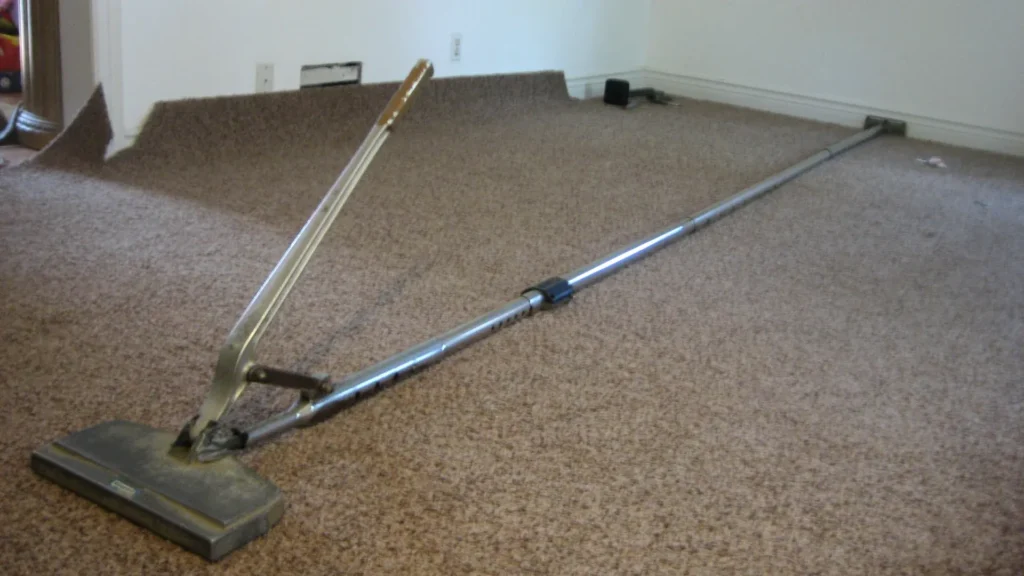
A power stretcher pulls the carpet taut across the room, applying even, controlled tension across a wide section – something a knee kicker alone can't do properly for a full room.
3
Re-Secure With Correct Tension
The carpet is re-secured to the tack strip with the correct tension – the reason a proper power-stretch holds where a knee-kicker-only fix tends to loosen again.
4
Check the Pad Underneath
While the carpet is pulled back, we check the pad underneath and flag any wear or damage before re-securing the carpet.
Signs You Need Restretching, Not Replacement
Visible Ripples or Waves
Ripples or waves you can see across the floor, and carpet that shifts or bunches near doorways, point to a stretching problem rather than worn-out carpet.
Spongy or Loose Underfoot
A spongy or loose feel underfoot is another sign the carpet has come loose from the tack strip, not that the carpet itself is worn out.
Fiber Still in Good Shape
If the carpet fiber itself is still in reasonable shape – not threadbare, not matted flat, no major sun-fading – restretching is almost always the more sensible fix than replacement, and it's a fraction of the cost.
Doors That Catch or Drag
A door that used to clear the carpet but now catches or drags can be a sign the carpet has bunched or loosened near the doorway.
What's Involved in a Restretch
Power-stretcher work, not just a knee kicker
Even tension across the full width of the room.
Re-securing to the tack strip
Correct tension so it doesn't loosen again in a season.
Trimming and finishing
Excess carpet trimmed and edges finished cleanly.
Kingston's Seasonal Swings Loosen Carpet
Humidity shifts between Kingston’s winters and summers cause carpet and padding to expand and contract, which gradually loosens the stretch even on carpet that was installed correctly. Restretching resets that tension without replacing anything, and it’s usually the right call before assuming worn-looking carpet needs to go.
When Restretching Isn't Enough
Restretching corrects tension, not underlying damage. If the carpet has delaminated (the backing separating from the primary fabric) or the padding underneath has broken down and compressed, pulling it tighter won't hold – the carpet will loosen again within weeks. In those cases replacement is the more practical route, and we'll tell you honestly if that's what we're seeing rather than restretching something that won't stay tight.
Kingston's seasonal swings play a role too. Carpet backing takes on moisture and relaxes in humid weather, so a room that felt fine in winter can develop noticeable ripples during a muggy Kingston summer. Waiting doesn't help – a rippled carpet gets walked on unevenly, which stresses the same high spots repeatedly and shortens the carpet's life compared to catching it early.
Related Carpet Services
If the carpet has burns, tears or seam damage as well as ripples, see carpet repair. When the pad underneath has broken down, carpet padding replacement is the fix, and when the backing has delaminated, carpet replacement is the practical route. If the carpet also needs a deep clean, see carpet cleaning. Lakeside homes in Bath and on Wolfe Island see more humidity, which is a common cause of ripples.
Carpet Restretching FAQs
How long does restretching take?
Most rooms take a couple of hours; larger areas or carpet secured on every wall take longer. We'll give you a time estimate after seeing the space.
Will restretching damage my carpet?
Not when it's done at the right tension – restretching is routine, but overstretching can pull seams or tear the backing, so we check older carpet before we start.
Can furniture stay in the room?
Light furniture can often stay; heavier pieces may need to be moved temporarily. We'll confirm what's needed when we scope the job.
How do I know if it's stretching or the carpet is worn out?
If the carpet looks flattened, thin, or faded across the whole surface, that's wear. If specific areas ripple, bunch, or feel loose while the fiber itself still looks fine, that's a stretching problem.
Fix Rippled or Loose Carpet
Usually a same-visit fix – no need to replace the carpet.
To provide the best experiences, we use technologies like cookies to store and/or access device information. Consenting to these technologies will allow us to process data such as browsing behavior or unique IDs on this site. Not consenting or withdrawing consent, may adversely affect certain features and functions.
Functional
Always active
The technical storage or access is strictly necessary for the legitimate purpose of enabling the use of a specific service explicitly requested by the subscriber or user, or for the sole purpose of carrying out the transmission of a communication over an electronic communications network.
Preferences
The technical storage or access is necessary for the legitimate purpose of storing preferences that are not requested by the subscriber or user.
Statistics
The technical storage or access that is used exclusively for statistical purposes.The technical storage or access that is used exclusively for anonymous statistical purposes. Without a subpoena, voluntary compliance on the part of your Internet Service Provider, or additional records from a third party, information stored or retrieved for this purpose alone cannot usually be used to identify you.
Marketing
The technical storage or access is required to create user profiles to send advertising, or to track the user on a website or across several websites for similar marketing purposes.