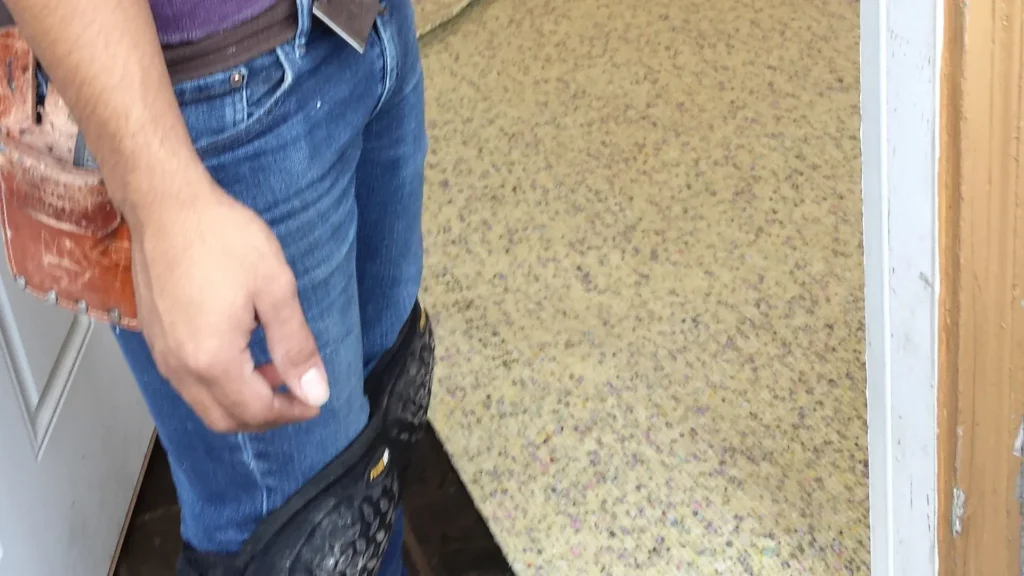
Carpet Experts Kingston provides home carpet installation throughout Kingston, Ontario, from a single bedroom to a whole-house renovation.
Request a Quote
Tell us about your project and we will get back to you within 24 hours.
Your information is secure and never shared.
Subfloor Conditions for Carpet Installation
Older Homes
Kingston's stone and brick homes built before the mid-1900s more often have original hardwood or uneven plank subfloors. Tack strip placement and padding choice both change when the subfloor isn't perfectly flat.
Newer Builds
Newer builds on Kingston's west and north sides are typically plywood or OSB subfloor. It's more straightforward, but still needs to be clean and properly fastened before carpet goes down.
Concrete and Below-Grade Floors
Basements and other below-grade rooms need moisture-aware pad selection in addition to a flat, clean slab, which we check for before quoting.
Assessed Before We Quote
We look at the actual subfloor in your home rather than assuming its condition from the age of the house alone, so the quote reflects what we will actually be working with.
What a Proper Installation Includes
Tack Strip and Padding
Tack strip goes around the room's perimeter, paired with the right-density padding for the carpet you've chosen.
Cutting, Seaming and Trimming
Carpet is laid, seamed and trimmed to fit the room.
Power-Stretching
A power stretcher pulls the carpet taut across the full width of the room rather than relying on a knee kicker alone. This is the step that gets skipped most often on rushed jobs, and skipping it is why so much carpet ripples or loosens within a year or two of installation.
Clean Job Site
Offcuts and debris are cleared as we go, so the room is left ready to use rather than needing a cleanup after we leave.
Carpet Seam Placement That Doesn't Show
Rolls and Seams
Carpet comes in rolls roughly 12 feet wide, with some styles in 15 feet, so any room wider than the roll needs at least one seam.
Planned Before Cutting
Seam placement is planned before cutting begins, ideally away from high-traffic paths and out of direct light, where a seam is least noticeable.
Why It Matters
Poor seam placement is one of the most common complaints about low-cost installations.
Pattern and Pile Direction
Pile direction and any pattern repeat are matched across a seam, not just the cut edge, so the join reads as one continuous surface rather than two mismatched pieces.
Our Process
Installation Day
1
Old flooring removed
Existing carpet or flooring cleared, if applicable.
2
Subfloor check
Subfloor cleaned and confirmed ready for tack strip.
3
Tack strip and padding
Perimeter tack strip and padding installed.
4
Fresh pad laid
New pad rolled out over the subfloor and trimmed to meet the edge of the tack strip, ready for carpet.
Our Process
Finishing Your Carpet Installation
1
Carpet laid and seamed
Carpet cut, seamed and fitted to the room.
2
Power-stretched and trimmed
Carpet stretched taut and edges trimmed cleanly.
3
Vents and thresholds finished
Transition strips and vent covers reset so the floor looks finished at every edge.
4
Final walkthrough
We walk the room with you to check seams and edges before calling the job done.
The Installation Step Most Rushed Jobs Skip
Power-stretching pulls carpet taut across the full width of a room using a mechanical stretcher, rather than relying on a knee kicker to work the material into place by hand. It takes longer than the shortcut version, but it’s the difference between carpet that stays flat for years and carpet that starts rippling within a season.
Stretch-In vs. Glue-Down Installation
Most residential carpet in Kingston is installed using the stretch-in method described above – carpet is stretched over padding and secured to tack strip around the room's perimeter. Glue-down installation, where carpet is adhered directly to the subfloor without padding, is less common in homes but sometimes used in basements, over concrete, or in areas that see rolling equipment or wheelchairs, since it doesn't shift or ripple the way a padded, stretched carpet can under sustained wheeled traffic.
Choosing Pile Type Before Installation Day
Pile type affects more than appearance. Loop pile and textured cut pile hide footprints and vacuum marks better than plush cut pile in high-traffic hallways, while looped and low-pile options tend to hold up better under heavy use. Homeowners planning a renovation should decide on pile type and density before measuring, since thicker, denser carpet needs slightly different padding and stretch tension than a thin builder-grade product.
To provide the best experiences, we use technologies like cookies to store and/or access device information. Consenting to these technologies will allow us to process data such as browsing behavior or unique IDs on this site. Not consenting or withdrawing consent, may adversely affect certain features and functions.
Functional
Always active
The technical storage or access is strictly necessary for the legitimate purpose of enabling the use of a specific service explicitly requested by the subscriber or user, or for the sole purpose of carrying out the transmission of a communication over an electronic communications network.
Preferences
The technical storage or access is necessary for the legitimate purpose of storing preferences that are not requested by the subscriber or user.
Statistics
The technical storage or access that is used exclusively for statistical purposes.The technical storage or access that is used exclusively for anonymous statistical purposes. Without a subpoena, voluntary compliance on the part of your Internet Service Provider, or additional records from a third party, information stored or retrieved for this purpose alone cannot usually be used to identify you.
Marketing
The technical storage or access is required to create user profiles to send advertising, or to track the user on a website or across several websites for similar marketing purposes.